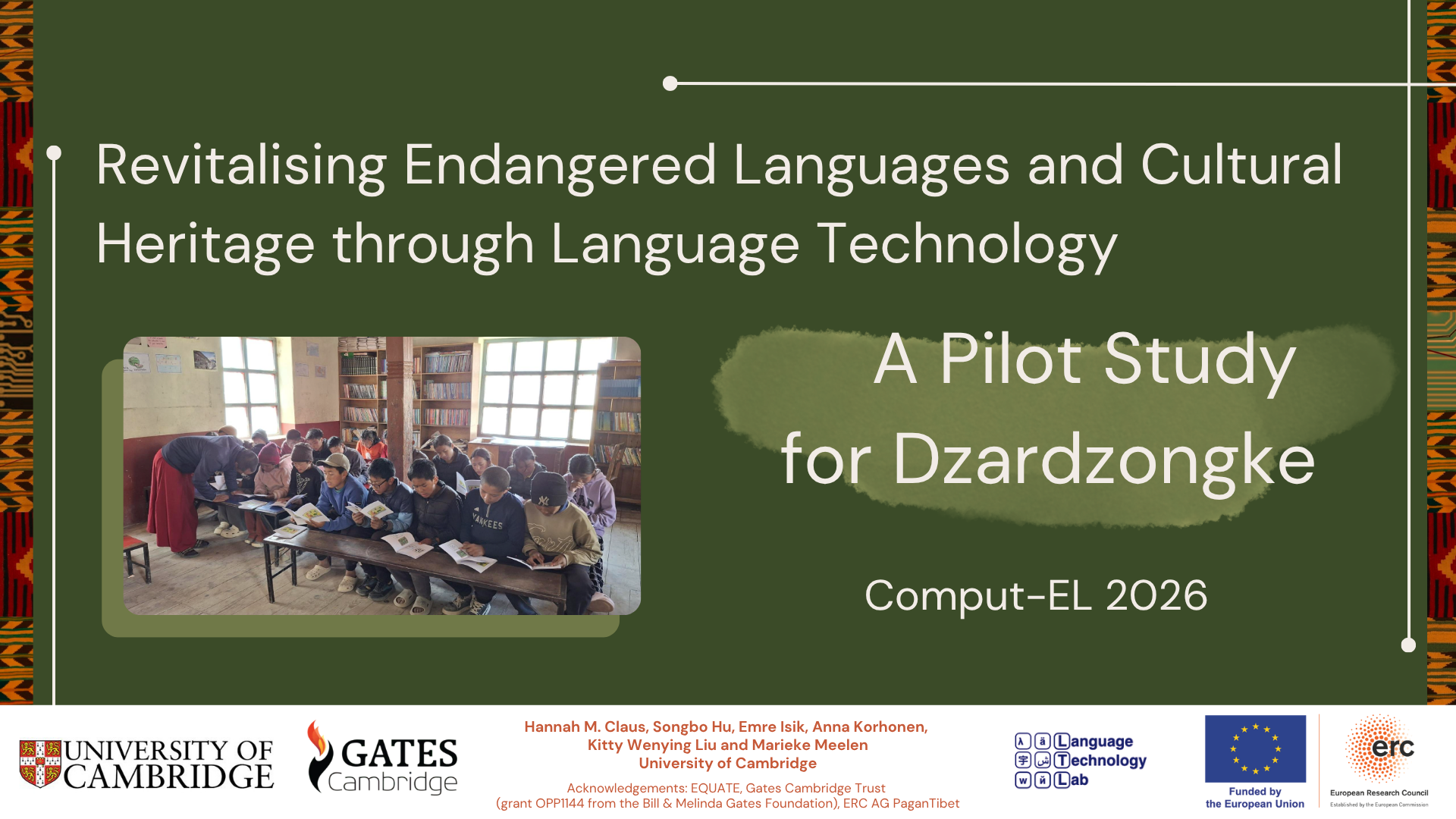
The first prototype of a mobile application built to help preserve and revitalise Dzardzongke, a Tibetic language spoken by a small community in South Mustang, Nepal. The pilot study, presented at ComputEL-9, shows how a community-centred app can support language and cultural heritage preservation. We also offer a template other endangered-language communities could adapt.
Motivation
Dzardzongke has no standard writing system until now and very little digital presence. Like many endangered, primarily oral languages, it risks losing ground to majority languages unless communities have accessible tools to record, teach, and pass on their own language and cultural heritage on their own terms.
Approach
We built a mobile prototype combining vocabulary learning, literacy activities in a newly standardised romanised orthography, and cultural heritage content, developed with the Dzardzongke-speaking community in South Mustang.
Presented at ComputEL-9
The pilot study was presented at the Ninth Workshop on the Use of Computational Methods in the Study of Endangered Languages (ComputEL-9), alongside other community-centred approaches to language technology.
Even the existence of a digital tool has proven symbolically significant for oral and endangered language communities.
Outcomes & impact
This is the first published output from the Dzardzongke work, and lays the groundwork for the fuller mobile-assisted learning and data collection pipeline evaluation now underway (see the related project on this site).
Collaborators
- Songbo Hu, University of Cambridge
- Emre Isik, University of Cambridge
- Anna Korhonen, University of Cambridge
- Kitty Liu, University of Cambridge
- Marieke Meelen, University of Cambridge
Credits & disclosure
Header image: Cover image created by Hannah M. Claus. Photo used taken by Marieke Meelen.
None of the text above was written or generated by AI.